What You're Actually Paying For: Breaking Down the Real Cost of Fine-Line Tattoo Work
The Sticker Shock Is Real — But So Is the Reason
If you've ever gotten a quote for a fine-line tattoo and felt your eyes go wide, you're not alone. Fine-line work consistently commands some of the higher rates in the tattoo industry, and for someone who's used to thinking of tattoos as a one-size-fits-all kind of expense, that can feel jarring.
But here's the thing: the pricing isn't arbitrary, and it definitely isn't pretentious. It's the result of a very specific set of factors — training costs, equipment investment, time commitment, and the particular demands of precision work — that add up in ways that are worth understanding before you book your appointment. Once you see what's actually behind the number, it tends to land differently.
Years of Specialized Training Don't Come Free
Every tattoo artist goes through some version of an apprenticeship, but fine-line tattooing demands a level of technical development that goes well beyond the basics. The margin for error in fine-line work is essentially zero — a slightly shaky hand, a needle that's even marginally wrong for the application, a moment of imprecision — and the result is visible in the finished piece in a way that it simply isn't in bolder, heavier styles.
Developing the steadiness, the eye for detail, and the technical fluency that fine-line requires takes years. Most skilled fine-line artists will tell you that they were tattooing for a long time before they felt genuinely confident in their precision work. That extended development period represents a real financial investment — in apprenticeship fees, in practice materials, in the time spent building skill rather than building income.
Many fine-line artists also invest in continuing education throughout their careers: workshops with other artists, anatomy and illustration courses, even formal art school training. All of that shapes their ability to produce the work you're paying for, and all of it costs money.
The Equipment Is Not Generic
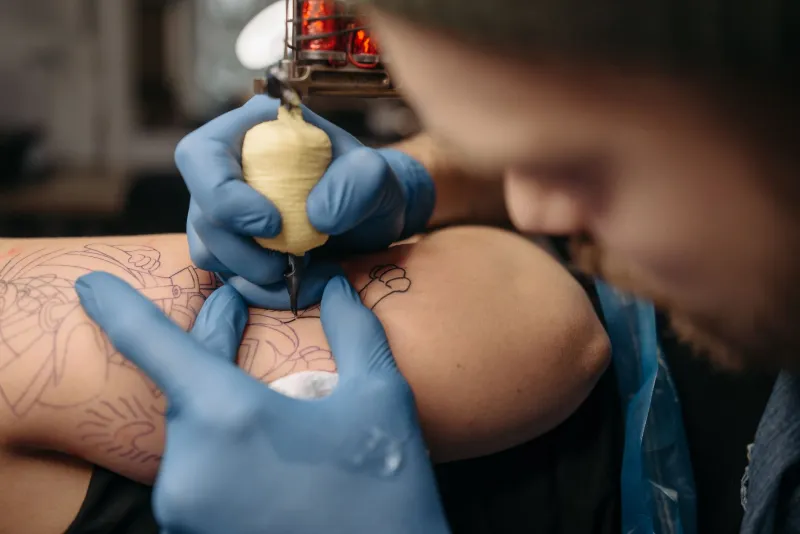
Fine-line tattooing requires specialized equipment, and specialized equipment costs more than the standard kit. The needle configurations used for fine-line work — single needles, tight round liners, specific groupings designed for delicate detail — are more expensive and used up more quickly than the broader configurations used in other styles. Fine-line artists go through needles faster because precision demands fresh, sharp points.
Machines matter too. The rotary machines preferred by many fine-line artists for their consistency and low vibration are a significant investment, and serious artists often maintain multiple setups for different applications. Quality ink — particularly the blacks and diluted gray wash tones that define so much fine-line work — isn't cheap either.
And then there's the studio itself. Fine-line work requires excellent lighting — the kind that lets an artist see every hair-thin line they're laying down in real time. It requires a clean, controlled environment. It requires equipment that's maintained to a higher standard than average. These aren't vanity expenses; they're operational requirements for producing quality work.
Time Is the Hidden Variable
One of the things that surprises people most when they start understanding fine-line pricing is how much time goes into a piece before anyone ever sits down in the chair.
Fine-line artists typically spend significant time on custom design work before each appointment. This isn't a quick sketch — it's a detailed process of developing the design, refining it, sizing it correctly for the placement, and often going through multiple rounds of revision with the client. For a complex botanical piece or a detailed portrait, pre-appointment design work alone might represent several hours of the artist's time.
The tattoo session itself also tends to run longer than clients expect. The precision required for fine-line work means the artist is working more slowly and deliberately than they might with a bolder style. Rushing fine-line work is how mistakes happen, and no serious artist is going to rush.
And after the session, there's often follow-up: answering aftercare questions, checking in on healing, sometimes scheduling a touch-up to refine any areas that need it. That ongoing relationship is part of what you're paying for.
The Luxury Framing Is Actually Accurate
Here's a comparison that tends to land well: think about how you'd evaluate the cost of a custom suit versus an off-the-rack option, or a piece of original artwork versus a print. The premium isn't about the materials alone — it's about the expertise, the customization, the time, and the guarantee of quality that comes with someone who's genuinely excellent at what they do.
Fine-line tattooing fits squarely in that category. You're not paying for ink and a needle. You're paying for years of developed skill, specialized equipment, custom design work, careful execution, and a result that will live on your body for the rest of your life. In that context, the premium starts to look less like a markup and more like an accurate reflection of value.
How to Think About the Investment
A few practical frameworks that might help:
Think cost-per-year, not cost upfront. A fine-line tattoo done well can look beautiful for decades with proper care. Spread that investment over the life of the piece, and the daily cost is genuinely minimal.
Compare to other luxury experiences. A single dinner at a nice restaurant in a major US city can easily run $100–$200 per person. A fine-line tattoo that takes four hours might cost $600–$1,000 or more — but it lasts forever. The math is actually pretty favorable.
Factor in the cost of doing it wrong. Laser removal is expensive, painful, and time-consuming. Choosing a less expensive artist who isn't truly skilled in fine-line work can result in a piece that fades unevenly, loses its detail quickly, or simply doesn't look right. The correction cost — financial and otherwise — often exceeds whatever you thought you were saving.
Aftercare Protects the Investment
One more thing worth noting: the value of a fine-line tattoo is directly tied to how well you take care of it. Precision ink is more sensitive to sun exposure, skin dryness, and improper healing than bolder styles. Investing in quality aftercare products and following your artist's guidance isn't optional — it's how you protect what you paid for.
Think of aftercare as the last line item in the budget. It's a small cost relative to the tattoo itself, and it has an outsized effect on how the piece holds up over time.
When you understand everything that goes into a fine-line tattoo — the training, the tools, the time, the expertise — the pricing stops feeling steep and starts feeling honest. That's a shift worth making before you book.