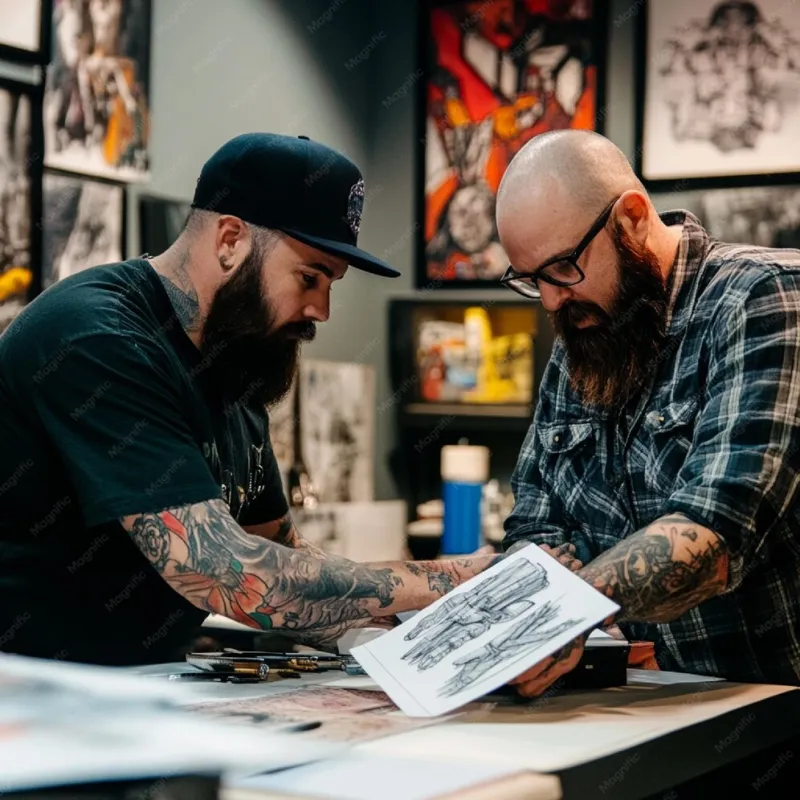
When the Answer Is No: How Fine-Line Artists Protect Their Craft (And Your Skin)
Walk into most tattoo studios in the US and the vibe is collaborative — you bring an idea, the artist refines it, and you both meet somewhere in the middle. But step into a fine-line specialty shop and you might hear something that surprises you: a flat-out no.
Not rude, not dismissive — just honest. And that honesty, it turns out, is one of the defining characteristics of artists who've built their careers on precision ink work.
The Precision Problem Nobody Talks About
Fine-line tattooing is a discipline built on constraints. The needles are finer, the lines are thinner, the margin for error is basically nonexistent. What makes the style so visually striking — that delicate, almost drawn-on quality — is also what makes it structurally unforgiving.
Artists who specialize in this style will tell you the same thing: not every design translates. A concept that looks incredible as a digital sketch or a Pinterest reference photo can fall apart completely when it's rendered in single-needle work on living skin. Shading gradients that seem subtle on paper can blur into muddy patches within a few years. Lettering that's technically readable at 10pt font might heal into an unrecognizable smear.
So when a fine-line artist tells you they won't do something, it's rarely about ego. It's about physics.
What Gets Rejected — And Why
The list of commonly declined requests in fine-line studios might surprise you. Hyper-detailed portraits with dozens of micro elements crammed into a small space. Requests to shrink an already complex design down to fit on a wrist. Lettering in ultra-thin script at a size that won't hold over time. Geometric patterns with line spacing so tight they'll bleed together before the ink even finishes settling.
Then there are the placement requests. Fine-line work on high-friction zones — fingers, inner wrists, feet, behind the ears — tends to fade unevenly and fast. Artists who care about their portfolio (and your long-term satisfaction) will often push back on these placements, or at least have a very candid conversation about what to expect.
One common thread among fine-line specialists is the concept of "tattoo integrity" — the idea that a piece should look as close to its original intention as possible five, ten, even fifteen years down the road. Every design decision gets filtered through that lens. If a requested element compromises the long-term integrity of the piece, it doesn't make the cut.
The Psychology of Hearing 'No'
Here's where it gets interesting. Most people seeking fine-line work are highly visual, often design-savvy, and have usually spent significant time curating exactly what they want. They've saved reference images, created mood boards, maybe even sketched rough concepts themselves. So when an artist redirects or declines part of that vision, it can feel like a personal rejection.
That emotional response is completely understandable — and fine-line artists know it. The good ones have learned to reframe the conversation almost immediately. Instead of leading with what won't work, they pivot to what will. They explain the why behind the limitation, then offer a path forward that preserves the client's original intent while keeping the work technically sound.
The clients who struggle most with this process tend to fall into a couple of categories. Some have done so much research that they've developed rigid expectations — they know exactly what they want and interpret any deviation as the artist not understanding their vision. Others are working from a reference image they love so much they can't see past it, even when the artist explains that replicating it pixel-for-pixel isn't actually possible in skin.
The breakthrough moment — for both parties — usually comes when the client starts to trust that the artist's pushback isn't about limitations in skill, but about a deeper understanding of the medium.
'No' as a Portfolio Statement
There's another layer to this worth unpacking: fine-line artists who say no frequently are often the most sought-after ones. Their refusals are, in a strange way, a quality signal.
When an artist is willing to turn down work — even paid work — to protect the standard of what leaves their studio, that tells you something. It tells you they're not just trying to fill appointment slots. They're curating a body of work. Every piece they put out into the world is a walking advertisement for their skill, and a compromised piece is a liability, not an asset.
This is especially true in the age of social media, where a poorly executed tattoo can circulate just as fast as a stunning one. Fine-line artists with strong Instagram followings or waitlists measured in months didn't get there by saying yes to everything.
How to Work With It Instead of Against It
If you're booking a fine-line consultation — or thinking about it — the best thing you can do is come in with a concept rather than a blueprint. Share the feeling you're going for, the references that inspired you, the elements that matter most to you. Then let the artist do what they do.
Ask questions when something gets redirected. "Why won't this work?" is a completely reasonable thing to ask, and any artist worth their needle will give you a real answer. That conversation is where you start to understand the craft at a deeper level, and where the best pieces actually get born.
If an artist declines your concept entirely — meaning they don't think they can execute it in a way that will hold up and look right — take that seriously. It's not a rejection of you. It's an artist being straight with you about what the medium can and can't do, and what they're willing to put their name on.
The Discipline Behind the Delicacy
Fine-line tattooing looks effortless. That's kind of the point — the whole aesthetic is built around a lightness of touch that makes the work appear almost gravity-defying on skin. But behind that apparent simplicity is an enormous amount of discipline, both technical and editorial.
The artists who've built real reputations in this space aren't just talented with a needle. They're rigorous thinkers who've developed a clear philosophy about what they will and won't create. That philosophy gets tested constantly — by excited clients, by trending design requests, by the pressure to take on more work than is sustainable.
Saying no is how they hold the line. And for clients who are willing to lean into that dynamic rather than fight it, the result is almost always something better than what they originally imagined.