Think You'll Regret It? Fine-Line Tattoos Are Actually Built for Changing Your Mind
Let's be honest. At some point, almost everyone who's ever considered getting a tattoo has also considered the worst-case scenario. What if I change my mind? What if this design doesn't feel like me in ten years? What if I just... don't love it anymore?
It's a completely fair thing to think about. Tattoos are permanent — that's kind of the whole point. But here's something the industry doesn't talk about nearly enough: not all permanent ink is created equal when it comes to how much wiggle room you actually have later on. And fine-line work? It might just be the most flexible "permanent" decision you can make.
Yeah, we know that sounds like a contradiction. Stick with us.
Why Boldness Isn't Always the Safer Bet
There's a common assumption that getting a small, delicate fine-line tattoo is somehow riskier than going bold — like a thick, saturated design is more "committed" and therefore more confident. But from a practical, long-term standpoint, the opposite is often true.
Bold tattoos — think heavy black fill, thick outlines, dense shading — deposit a significantly higher volume of ink into the skin. More ink means more pigment to break down if you ever pursue laser removal. It also means less room for an artist to work over the design if you want a cover-up later. A solid black piece the size of your palm is a very different challenge to address than a fine-line botanical illustration of the same size.
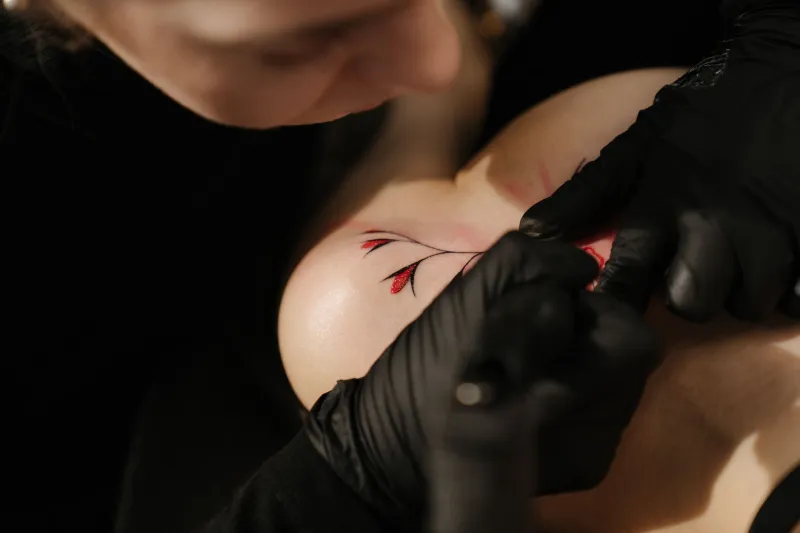
Fine-line work, by contrast, uses minimal ink to achieve maximum detail. The lines are precise but relatively sparse. That restraint — the very thing that makes fine-line tattoos look so refined — is also what makes them easier to adapt, modify, or remove when life takes an unexpected turn.
The Laser Removal Factor
Let's talk about laser removal for a second, because it's still one of the most misunderstood parts of the tattoo conversation. A lot of people think it's a nuclear option — painful, expensive, and only partially effective. And while it's true that complete removal isn't always guaranteed, the process is genuinely more efficient with fine-line work.
Laser removal works by breaking down ink particles so your body can flush them out over time. The less ink there is to break down, the fewer sessions you typically need, and the cleaner the final result tends to be. Fine-line tattoos, with their lighter ink deposits and absence of heavy fill, respond more readily to laser treatment than bold, saturated pieces.
That doesn't mean removal is a walk in the park — it's still a process that takes time and money. But if you're someone who's on the fence about commitment, knowing that your fine-line piece is more laser-friendly is genuinely useful information.
Designing With Evolution in Mind
Here's where things get really interesting. Some fine-line artists have started talking about what they call "intentional evolution" — the idea of designing a tattoo not just for how it looks today, but for how it could grow or change over time.
The concept is pretty simple: instead of treating your tattoo as a fixed, finished object, you treat it as a starting point. A delicate single-stem flower on your forearm could eventually become part of a larger botanical sleeve. A minimal geometric shape could be incorporated into a more complex composition years down the line. Fine-line work lends itself to this kind of layering because its visual language is naturally open-ended — there's always room to add without overwhelming.
Bold tattoos can evolve too, of course, but the options are more constrained. When you've already committed to a dense design, the next step almost has to be bigger or darker, which isn't always what people want. Fine-line work gives artists — and clients — a more nuanced set of possibilities.
What Artists Are Actually Saying
Talk to enough fine-line artists and a pattern emerges. A lot of their clients come in specifically because they've been burned before — either by a tattoo they regret or by the fear of getting one at all. Fine-line work tends to attract people who think carefully about what they put on their bodies, and those clients often ask the same question: "What are my options if this doesn't work out?"
The answer fine-line artists give is usually more reassuring than people expect. Because the ink is applied with such precision and in such controlled quantities, there's far more flexibility for future intervention — whether that's adding to the design, incorporating it into something new, or pursuing removal. The technical discipline that defines fine-line tattooing isn't just about aesthetics. It has real, practical implications for what happens to your skin five, ten, or twenty years from now.
Cover-Ups: A Different Conversation
Cover-up tattoos are their own art form, and they come with real limitations regardless of what you're working over. But fine-line tattoos do present a more manageable canvas for a skilled artist.
Because fine-line designs don't rely on heavy saturation or thick outlines, an artist working on a cover-up has more tonal range to play with. They can go darker without hitting a ceiling too quickly. They can work around the existing lines rather than simply burying them. In some cases, a fine-line piece can even be incorporated into a new design rather than covered entirely — which often produces a more interesting result anyway.
This is worth thinking about when you're in the consultation phase. If you're someone who's historically indecisive, or if you're getting a tattoo that feels meaningful right now but might feel differently in a decade, talking to your artist about cover-up-friendly design choices is a smart move. Fine-line work, with its lighter touch, naturally sits on the more adaptable end of that spectrum.
The Real Takeaway
None of this is an argument for treating your tattoo carelessly or assuming you can just "undo" it whenever you feel like it. A tattoo is still a significant decision, and it deserves the thoughtfulness that goes along with that.
But the idea that bolder automatically means braver, or that delicate somehow means less committed, doesn't hold up when you look at the full picture. Fine-line tattoos ask for a different kind of confidence — the kind that's comfortable with nuance, open to change, and smart about the long game.
If you've been holding off on getting inked because you're worried about permanence, fine-line work might actually be the most honest answer to that fear. It's still permanent. It's still meaningful. It just happens to leave the door open a little wider than you'd think.