Hidden in Plain Sight: Why Fine-Line Tattoos Are the Professional's Best-Kept Secret
There's a particular kind of freedom in carrying something no one else can see. A lawyer who has a delicate botanical sprig traced along her inner wrist, covered entirely by a watch. A finance director with a single thin constellation running along his collarbone, invisible beneath a button-down. A surgeon with a hair-thin script tattoo tucked behind her ear, only visible when she pulls her hair up on weekends.
These aren't accidents of placement. They're decisions — careful, strategic, and deeply intentional ones.
Fine-line tattooing has quietly become the unofficial uniform of the professionally ambitious and the personally expressive. And understanding why requires looking honestly at where American workplace culture actually stands right now.
The Bias Is Real — Even If Nobody Says It Out Loud
Despite years of cultural progress, visible tattoos still carry professional baggage in many industries. A 2022 study published in the Journal of Retailing and Consumer Services found that customers across multiple sectors — finance, law, healthcare, and hospitality — consistently rated visibly tattooed service providers as less competent, regardless of their actual performance. That's not a fringe finding. It reflects a persistent bias that plenty of tattooed professionals navigate every single day.
And it's not just client-facing roles. Internal corporate culture can be equally unforgiving. Promotions, first impressions during interviews, client pitches — the calculus of how you're perceived matters, and many people aren't willing to gamble their career trajectory on someone else's comfort level with ink.
So what do you do when you want the tattoo but can't afford the professional risk? You go fine-line. And you go strategic.
Placement Is Everything
The real genius of fine-line tattooing for professional clients isn't just the aesthetic — it's the geometry. The delicate scale of fine-line work opens up placement options that bolder styles simply can't access with the same discretion.
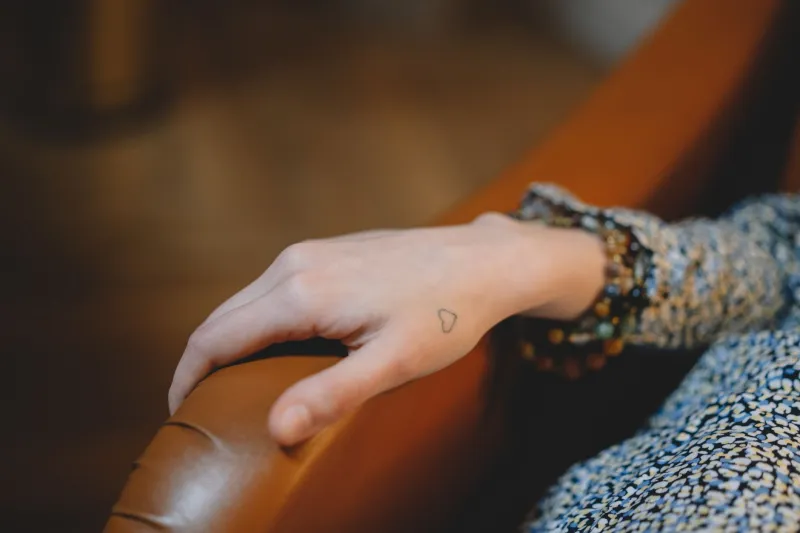
Inner wrists are a classic choice, easily covered by a watch or a bracelet. The upper ribcage sits completely invisible beneath most professional attire. Behind the ear works for anyone with longer hair. Inner biceps, the nape of the neck, the top of the foot — these are what fine-line artists sometimes call "professional placements," spots that are easy to conceal in formal contexts and just as easy to reveal on your own terms.
"I have clients who are very clear from the first consultation," says one New York-based fine-line artist. "They'll come in with their work outfit on and point exactly where the tattoo needs to stay hidden. That's a real design constraint, and honestly, it makes for more interesting work because the placement becomes part of the concept."
The precision required for fine-line work also means smaller, more refined designs that tuck neatly into these discreet spots without looking cramped or illegible. A bold traditional piece needs room to breathe. A fine-line illustration of a moth or a single Roman numeral date can live in a two-inch space and look completely intentional.
The Psychology of Subtle Self-Expression
There's something worth unpacking about why this matters so much to people. Why get a tattoo at all if you're going to hide it?
The answer has less to do with showing the tattoo and more to do with having it. Psychologists who study self-concept and personal identity have long noted that private markers of identity — things only you know about yourself — carry significant psychological weight. They function as anchors. A reminder of who you are underneath the professional persona.
For many corporate clients, the tattoo isn't about broadcasting an identity. It's about protecting one. It's a quiet act of self-preservation in environments that can feel relentlessly homogenizing.
"My tattoo isn't for my boss," one client, a mid-level marketing executive in Chicago, explained. "It's for me. It's there when I need to remember that I'm a whole person with a whole life outside of quarterly reports. That's worth something."
This is the visibility paradox at its most human: the tattoo is most powerful precisely because it's invisible to everyone who might judge it.
Fine-Line as the Great Workplace Equalizer
There's also a class and access dimension here that's worth acknowledging. Professional dress codes and appearance standards have historically functioned as gatekeeping mechanisms — and tattoos have long been caught in that net. The rise of fine-line tattooing hasn't erased that dynamic, but it has created a workaround that gives people more agency.
When a tattoo can be a whisper instead of a shout, it becomes accessible to people who previously felt forced to choose between their identity and their career. That's a genuine cultural shift, even if it's happening quietly.
Studios that work frequently with professional clients often develop a kind of fluency in this conversation. They understand that a consultation might involve discussing not just what someone wants, but where they can realistically wear it given their specific professional context. That's a different kind of client service — more nuanced, more collaborative.
What Fine-Line Artists Want You to Know
If you're a professional considering your first fine-line piece, here's the practical reality from artists who work with this demographic regularly:
Be honest about your workplace. Don't downplay the constraints. A good fine-line artist will use those constraints creatively rather than fight them.
Think long-term about placement. The inner wrist is popular for a reason, but it's also one of the first places people look. Consider spots that require more active effort to see — ribcage, inner arm, upper back.
Scale matters more than you think. Fine-line work that's too small can lose detail over time, especially in high-movement areas. Your artist can help you find the sweet spot between discreet and durable.
The design can carry the meaning even without scale. You don't need a large piece to say something significant. Fine-line tattooing is built for compression — for saying a lot in a small, precise space.
The professionals filling fine-line appointment books across the country already know this. They've figured out that ink and ambition aren't mutually exclusive — you just have to be a little clever about the geometry.